Most sealcoating jobs look great the day they’re done. The parking lot is dark, clean, and sharp. The lines pop. The property looks taken care of.
The real question is what it looks like two or three years later.
If you’ve had a parking lot that faded faster than it should have, showed tire marks and scuffing within the first season, or started wearing thin before you expected it, the problem usually isn’t the product. It’s how that product was mixed, applied, and put down on your pavement.
That distinction matters, because it’s the difference between a sealcoating job that protects your asphalt for four to five years and one that’s back to looking rough in two
When property owners start searching for parking lot sealcoating or blacktop sealcoating, the assumption is often that the service is pretty standard across the board. Pick a price, get it done.
It’s not that simple.
Two asphalt sealcoating contractors can pull up to your property with similar-looking equipment and similar-sounding proposals and get completely different results. The material they use, how they mix it, and how they apply it all determine how long that coat actually holds.
That’s not a sales pitch. It’s just how the process works and most property owners don’t find out the difference until they’re looking at a lot that’s already failing.
A quality asphalt sealcoat isn’t just liquid sealer. A proper system includes a high-quality asphalt or refined tar emulsion base, polymer additives for flexibility and durability, and sand for traction and wear resistance.
Those additives aren’t optional extras. The polymers keep the coating flexible so it doesn’t go brittle and crack under temperature swings. The sand gives the surface something to grip so it resists scuffing under traffic. Without them, a sealcoat may look fine on day one and start breaking down well before it should.
This is one area where sealcoating companies vary significantly. Some use full-spec mixes. Others dilute or skip additives to cut cost. You can’t tell the difference by looking at the truck.
Sealcoat material contains sand, additives, and liquids that naturally separate if they aren’t continuously agitated. If a contractor’s equipment isn’t keeping the mix properly blended throughout the job, what goes down on your pavement isn’t consistent.
Sand settles to the bottom. Additives separate. The first section of your lot gets a different product than the last. That shows up as streaking, weak spots, early wear, and peeling, the kind of failure that gets blamed on the product when the real culprit is the equipment.
We use machinery that continuously mixes and conditions the material from the first gallon to the last. It’s not a small detail. It’s the difference between a uniform coat and an inconsistent one.
Spray-only application is fast. It’s also where a lot of sealcoating contractor work falls short.
When a crew sprays everything and moves on, you get uneven film thickness, oversprayed edges, and missed transitions around curbs, joints, and tight areas. Those thin spots and unsealed edges are exactly where wear starts early and water finds its way in.
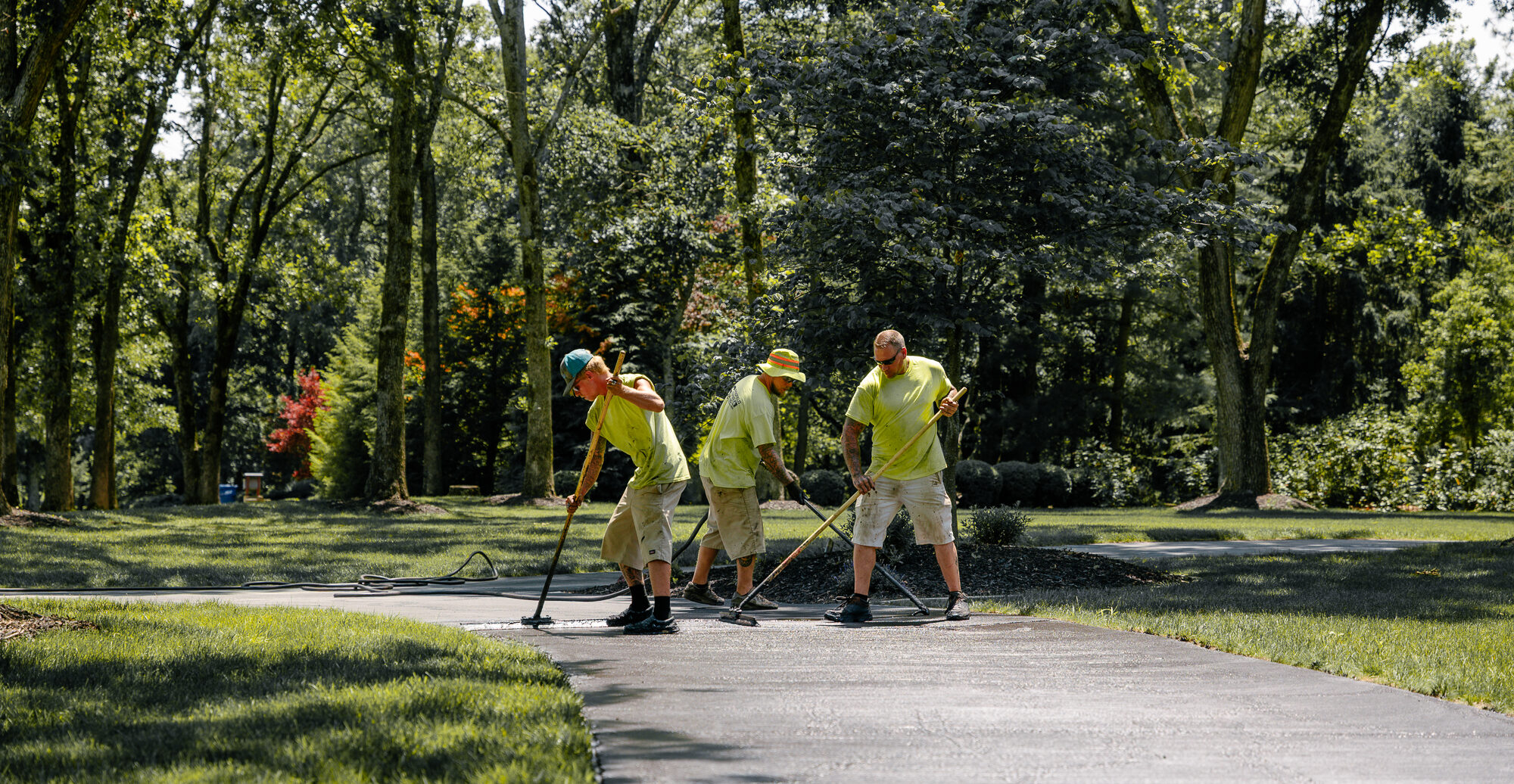
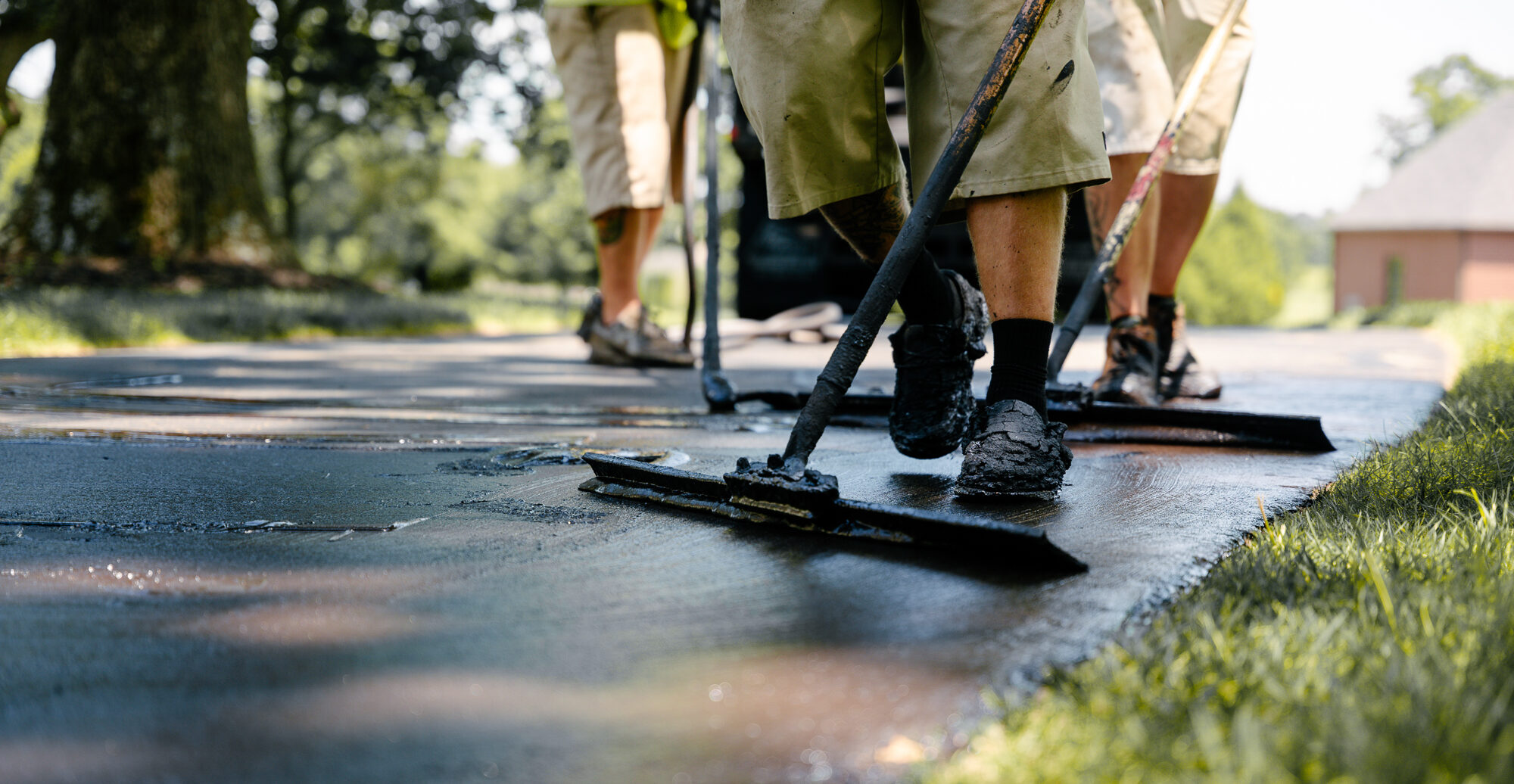
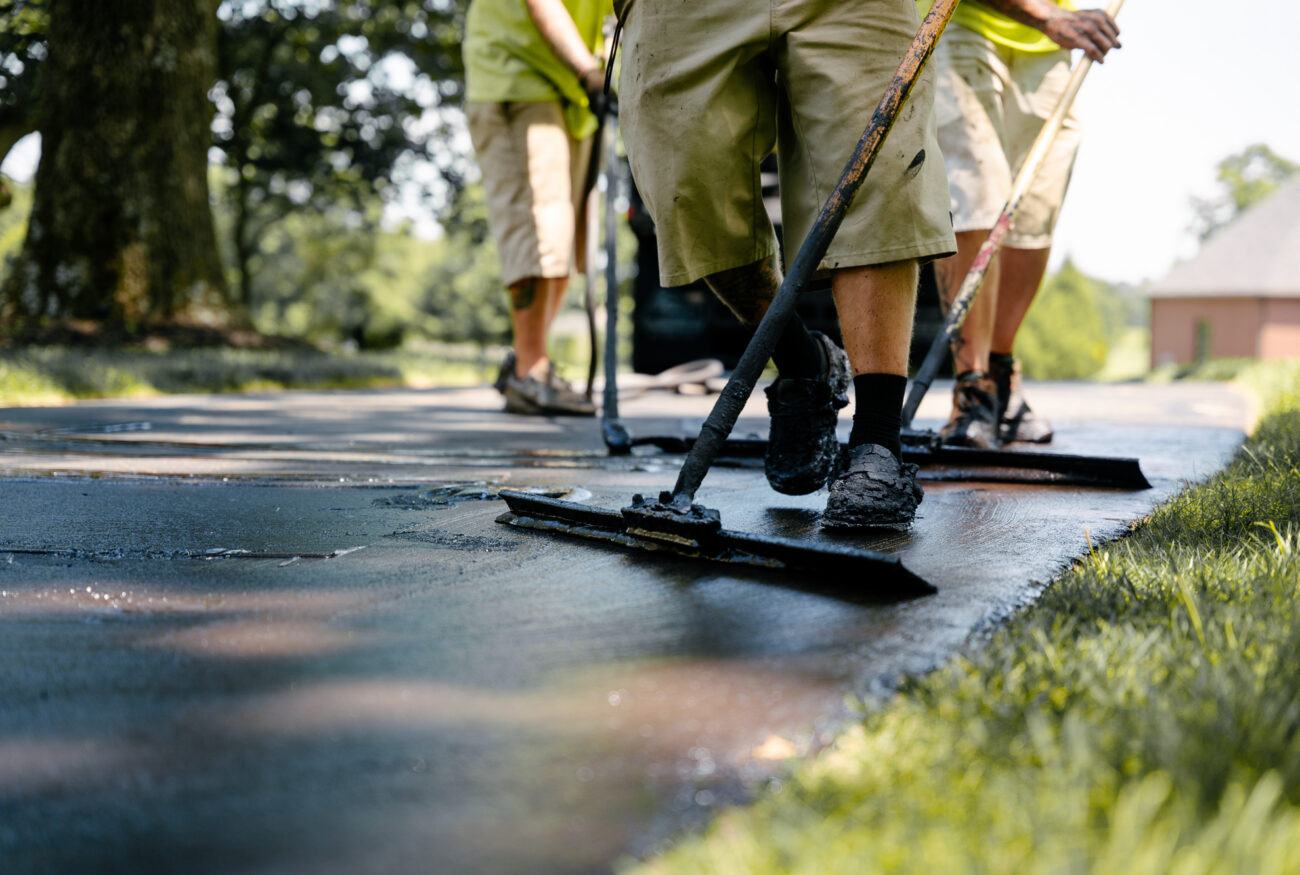
Our process uses a combination of spray and hand application. Spray for efficiency across open areas, hand work for edges, transitions, and anywhere the spray can’t do the job right. It takes longer. It delivers a cleaner result and a coat that holds up evenly across the entire surface, not just the easy parts.
If you’ve had a bad experience with a previous sealcoating job, it almost always comes back to one of three things:
Poor mixing. Material separates in the tank and goes down unevenly. Some areas get a full coat. Others get a thin, weak layer that starts breaking down fast.
Thin application. Stretching material further than it’s meant to go is one of the oldest shortcuts in the business. It looks applied. It isn’t protected.
Spray-only work. Fast to do, inconsistent in result. Edges and transitions get oversprayed or missed entirely, and those are the first spots to fail.
None of these are obvious on day one. They all show up by year two.
When you’re comparing driveway sealcoating quotes or evaluating options for a commercial parking lot, price is an easy shortcut. It’s also a misleading one.
A lower-cost job that lasts two years before needing to be redone costs more per year of protection than a properly applied system that holds up for four to five. When you run the math on cost per year rather than cost per job, the quality application usually wins, sometimes by a significant margin.
This is true whether you’re maintaining a single driveway sealcoating or managing multiple commercial properties. The cheapest option at the proposal stage has a way of becoming the most expensive option over time.
That’s not an argument for overpaying. It’s an argument for knowing what you’re actually buying.
Whether you’re a property manager or a homeowner trying to find the right asphalt sealcoating contractor for your driveway or parking lot, the questions that matter most aren’t about price. They’re about process.
Ask any contractor you’re considering:
An asphalt contractor who does this work the right way can answer all of those clearly and specifically. If the answers are vague, or if the contractor seems caught off guard by the questions, that tells you something.
Our goal is to protect your pavement, extend its useful life, and reduce how often it needs to be resealed, which means doing the job right the first time instead of doing it twice.
That starts with full-strength materials, properly mixed equipment, and a two-method application process that doesn’t cut corners on edges and detail work. It’s the same Springfield Standard we hold across every service we provide, from parking lot striping to full-depth paving.
If you’re looking for sealcoating and want a straight answer on what your pavement actually needs, contact Springfield Striping & Sealing to schedule an evaluation. We’ll tell you what we see and what we’d recommend, no pressure, no upsell.
A properly applied asphalt sealcoat using quality materials and a full-spec mix should last four to five years under normal traffic conditions. Jobs that fail in two years or less are typically the result of poor mixing, thin application, or skipped additives, not the product itself.
Most commercial lots benefit from parking lot sealcoating every two to four years depending on traffic volume, sun exposure, and the condition of the surface. A qualified sealcoating contractor can assess your specific lot and recommend a schedule that makes sense for your property and budget.
Yes. Driveway sealcoating protects the asphalt binder from UV damage, water infiltration, and chemical spills, the three main things that age pavement prematurely. Applied on the right schedule, it extends the life of your driveway significantly and is considerably less expensive than asphalt resurfacing or replacement down the road.
On day one, very little. Both look dark and freshly done. The difference shows up in year two and three, in how evenly the surface is wearing, whether edges are holding, and whether the coating is still providing real protection or just sitting on top of degrading pavement. The mix, the equipment, and the application method are what determine which outcome you get.
Ask about their process before you ask about their price. A reliable asphalt sealcoating contractor should be able to tell you exactly what’s in their mix, how their equipment keeps material agitated, and how they handle edges and transitions. Whether you’re searching for blacktop sealcoating near me or evaluating driveway sealcoating companies in your area, process questions separate the contractors who do this right from the ones who don’t.
Generally yes, though commercial applications often require more attention to high-traffic zones, heavy load areas, and drainage transitions. Commercial asphalt paving contractors with sealcoating experience understand how to spec the job for volume and wear patterns. Residential asphalt paving contractors focus more on driveway durability and curb appeal. Springfield Striping & Sealing handles both.